

Innovative Projects in Northern Delta and Upper Egypt Empower Women and Promote Sustainable Farming Practices
Amid growing global environmental challenges driven by climate change, adopting sustainable agricultural policies and practices has become essential—particularly in developing countries that face fragile ecosystems and scarce resources. Within this context, the Global Environment Facility’s Small Grants Programme (GEF/SGP) plays a pivotal role in supporting community-led initiatives aimed at combating land degradation and enhancing food security, through funding innovative, locally managed projects in partnership with civil society organizations.
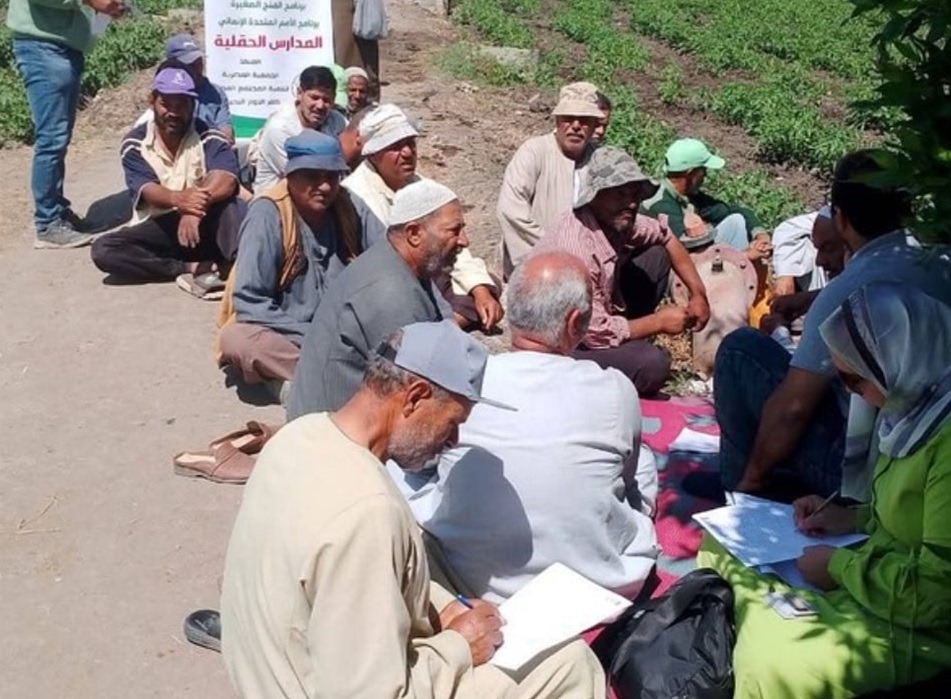
Field Schools: Empowering Farmers to Face Climate Change
In Beheira Governorate, particularly in Kafr El-Dawar and Abu Hummus, the project on Climate Change Adaptation and Agricultural Land Protection has successfully transformed farmers into field experts through the establishment of “Field Schools.” Implemented by the Egyptian Association for Local Community Development, the project focuses on key crops such as wheat, rice, and tomatoes, enabling farmers to make informed, knowledge-based agricultural decisions that enhance productivity and conserve soil health.
Complementing its awareness approach, the project organized a seminar on the hazards of burning agricultural waste and promoted its reuse in producing valuable resources such as compost and silage, emphasizing the vital role of environmental media in shifting negative agricultural practices.
“Azolla Egypt”: Women’s Empowerment and Green Entrepreneurship
Also in Beheira, the project “Azolla… Egypt’s Green Gold” presents a pioneering model for women’s economic and environmental empowerment. Through specialized training in marketing Azolla-based products in the villages of Kafr El-Dawar, participating women learned to produce eco-friendly green fodder and poultry products fed with Azolla. Implemented by the Integrated Services Association, the initiative promotes self-sufficiency, reduces dependence on industrial feed, and enhances women’s participation in the green economy.
Community Dialogue for Sustainability in Luxor
In Armant, Luxor Governorate, under the project “Together for Building Sustainable Agricultural Communities,” the Future Pioneers Association for Economic Development, in cooperation with the Al-Noor Community Development Association, organized awareness activities promoting sustainable agriculture using sugarcane seedlings. These dialogue sessions engaged women, girls, and young farmers in understanding the benefits of seedling cultivation—such as water conservation and productivity improvement—thus fostering community-based agricultural knowledge and strengthening the concept of “dialogue-driven agriculture”, a key step toward achieving comprehensive and sustainable food security.
Al-Adaimah: Organic Wheat Against Climate Change
In Al-Adaimah Village in Esna, Luxor, the project “Applications of Regenerative Agriculture to Address Climate Change Impacts”, implemented by the Coptic Association for Social Care, provides a successful scientific and community model for tackling climate change. It promotes improved wheat varieties that are disease-resistant and high-yielding, alongside the establishment of an integrated compost production system that transforms agricultural residues into organic fertilizer—enhancing soil quality and fertility.
“Bidayet Khair”: Women Confronting Land Degradation
In Qena Governorate, the “Bidayet Khair” Project for combating environmental pollution and agricultural land degradation, implemented by the Karama Association for Comprehensive Development in Al-Ashraf, reached 550 women—mostly farmers’ wives—in five villages. The project conducted a series of awareness seminars on the dangers of burning agricultural waste and promoted the use of compost as an alternative to chemical fertilizers. It also encouraged the cultivation of aromatic plants such as fennel, enhancing their value chains. Among its key achievements was the conversion of banana tree waste into 150 tons of compost. The project was praised by a visiting Japanese delegation and representatives from various ministries, underscoring its success as a replicable model for sustainable rural development.