

Partners of the Small Grants Programme Raise the Slogan: “Solutions Come from the Land and Begin with the People”
In the heart of Upper Egypt, amid the ancient fields inherited by generations of farmers, Luxor Governorate is witnessing a remarkable environmental and developmental transformation led by local communities. Supported by the Small Grants Programme (GEF/SGP) as part of its Operational Phase 7 in Egypt, these initiatives focus on adapting to climate change and building resilient, sustainable agricultural communities.
Solar Energy: Clean Irrigation for the Future
In an unprecedented step for the region, the Om El Qura Society for Community Development in Esna announced the establishment of a solar-powered irrigation station under its ambitious project, “Bader – Towards a Green Future in Esna.”
The project aims to transform irrigation systems in agricultural lands into sustainable, energy- and water-efficient models. The upcoming solar station marks a crucial step toward reducing diesel dependency, cutting emissions, and supporting farmers in managing production costs and adapting to climate fluctuations — paving the way for a more sustainable and equitable agricultural future.
Women at the Heart of Sustainable Agriculture
Environmental change is not driven by energy alone, but by people and knowledge.
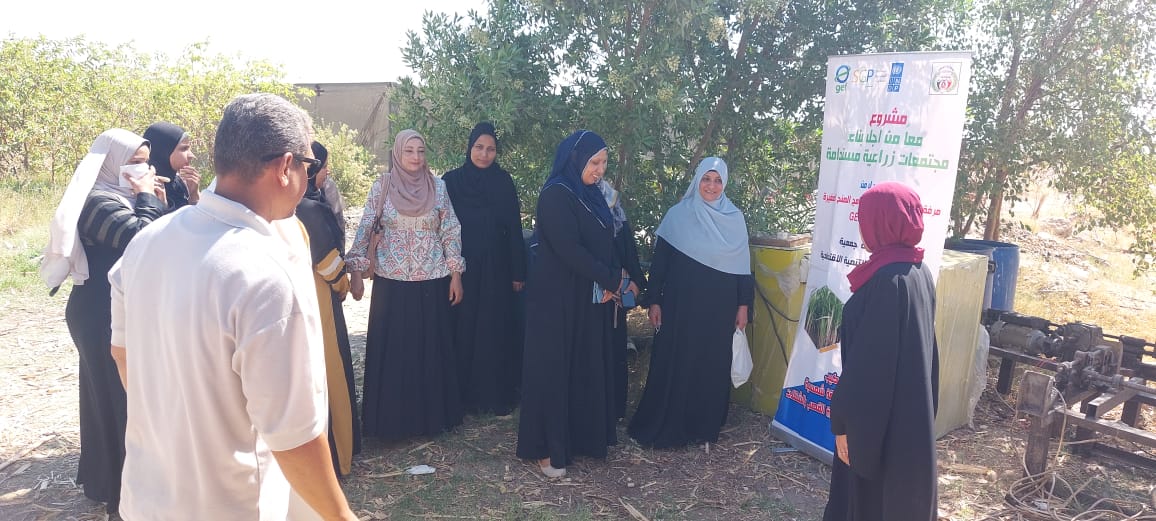
In this spirit, the Pioneers of the Future Association for Economic Development in El-Mahameed Bahary, Armant, organized an educational visit to a sugarcane seedling nursery in Esna, under the project “Together for Building Sustainable Agricultural Communities,” in cooperation with the El-Masr El-Aly Research Station.
A group of women and young girls interested in agriculture participated, learning about the advantages of seedling cultivation compared to traditional planting — including water conservation, higher productivity, and better crop quality.
The visit was more than a training session; it was the beginning of genuine empowerment for rural women — enabling them to play an active role in agricultural decision-making and become holders of knowledge and innovation.
Green Villages and Climate-Resilient Communities
Transformation in Esna goes beyond these two projects. It extends to other initiatives that share the same vision but use diverse tools.
Among them is the project “Applications of Regenerative Agriculture to Combat Climate Change Impacts,” implemented by the Coptic Association for Social Care, which supports farmers through low-emission agricultural practices and efficient natural resource management.
Another initiative, “Together for Building Climate Resilience – Green Village,” led by the Ma’an for Development Association in Asfun village, translates the concept of climate adaptation into tangible action through tree planting, improved irrigation practices, and raising awareness about the right to a safe and healthy environment.
Esna: From Marginalization to Green Leadership
What is unfolding in Esna is more than a series of environmental projects — it is a comprehensive development movement where clean technology meets social empowerment.
Under the slogan “Solutions Come from the Land and Begin with the People,” and with the support of the Small Grants Programme, community participation, and the engagement of local NGOs, Esna’s villages are turning into an open laboratory for sustainable development.
These efforts are redefining the relationship between people and their land, and between the environment and society.
What unites the solar irrigation station, the sugarcane nursery, regenerative farming practices, and climate-resilient villages is one noble idea:
True development is not imposed from the outside — it grows from within, nourished by local knowledge and the community’s determination to build a better future for themselves and generations to come.
With its rich history and deep-rooted connection to the land, Luxor is poised to become a regional model for climate adaptation and community resilience in the face of future challenges.