
As part of the follow-up to the 7th Operational Phase of the Global Environment Facility’s Small Grants Programme (GEF/SGP) — implemented across seven governorates within four geographic regions — a series of local platform meetings were organized in Cairo, Giza, Alexandria, and Beheira. The meetings were attended by Dr. Emad El-Din Adly, National Coordinator of the programme, and Dr. Hala Yousry, Chairperson of the National Steering Committee, alongside executive officials and environmental and development experts from the respective governorates.
The local platform meetings began in Alexandria on May 5, where two ongoing projects were reviewed: “Sustainable Youth Communities”, implemented by the Forum for Dialogue and Participation for Development across youth centers in Alexandria and Cairo, and “Green Universities for a Better Future”, led by the Our Earth’s Climate Foundation for Sustainable Development at the Faculty of Pharmacy, Alexandria University.
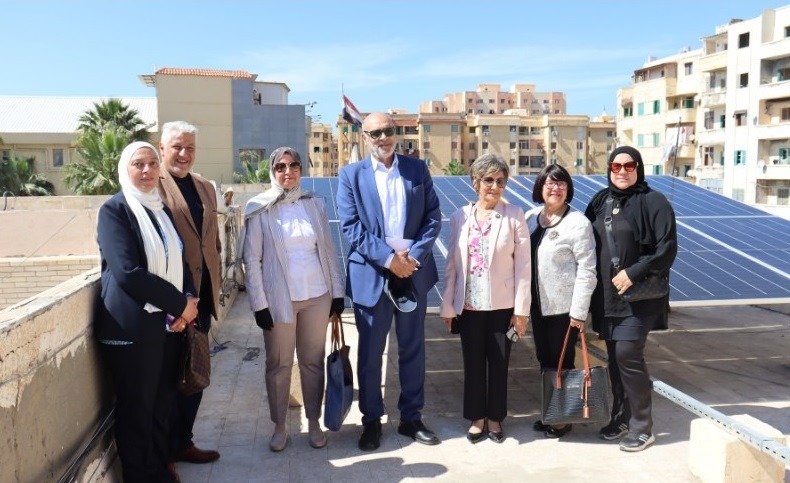
The GEF/SGP team also conducted a field visit to the Marine Youth Center in Anfoushi, inspecting the newly installed 9.44 kW solar power station, as well as water conservation units, waste separation systems, and solar-powered phone charging stations — marking the center as a model for environmentally sustainable community service.
The following day, the team held the Beheira Local Platform Meeting, where two projects were reviewed:
“Climate Change Adaptation and Agricultural Land Protection – Field Schools”, implemented by the Egyptian Association for Local Community Development in several villages of Kafr El-Dawar and Abu Hummus; and
“Azolla Egypt – The Green Gold”, implemented by the Integrated Services Association in Kafr El-Dawar.
After the meeting, the team visited a model wheat field in Kom El-Baraka Village, where the wheat harvest season had just begun. Dr. Adly praised the “Field Schools” project for promoting smart and sustainable farming techniques for strategic crops, particularly wheat, describing it as a replicable model for climate adaptation and food security enhancement across Egypt.
The team also visited one of the “Azolla Egypt” project sites, where Dr. Hala Yousry commended the innovative technologies applied under the supervision of the Desert Research Center, emphasizing that the project plays a vital role in empowering rural women economically by supporting dozens of underprivileged families. She reaffirmed that “true development begins with empowering the most vulnerable groups.”
Later that week, the Greater Cairo Local Platform Meeting was held at the Cairo House Environmental and Cultural Center, with wide participation from civil society and government entities. During his address, Dr. Adly highlighted that the local platforms serve as a vital mechanism to monitor the 7th Operational Phase (2022–2026) projects, stressing that community partnership and transparency are key to their success.
Dr. Hala Yousry reiterated that the programme has adopted a participatory approach since its inception — involving communities in the design, implementation, and evaluation of projects to ensure effective and sustainable local outcomes. Meanwhile, Eng. Samah Saleh, Sustainable Development Officer at the Ministry of Environment, emphasized that women’s empowerment must be an integral component of every successful environmental initiative, reaffirming the Ministry’s full support for civil society-led efforts in climate action and recycling.
The meeting also reviewed nine projects being implemented in Cairo and Giza under SGP funding, including:
“Waraq Green” (Beit Ala El-Sakhr Association),
“Eco-Friendly Youth Centers” (Egyptian Leadership Foundation for Development),
“Sustainable Plastic Waste Management” (Al-Rowad Foundation for Projects and Development),
“Sustainable Youth Communities” (Forum for Dialogue and Participation for Development),
“Green Cairo” (Shabab Misr Association for Development and Environment),
“Green Squares” (Ezra’ Shagara Foundation for Social Development),
“Using Solar Energy in Industry” (Sawa Ala El-Ganna Association for Development), and
“Solar Power Generation” (Nahdet Mansouria Association for Development).
The meeting concluded with a review of the “Knowledge Management, Communication, and Innovation Stimulation” project, implemented by the Environmental Writers and Development Association, outlining future plans for documenting success stories, enhancing community communication, and promoting environmental innovation.
The session ended with an open discussion affirming the Small Grants Programme’s critical role in tackling environmental challenges through community-driven, innovative, and sustainable solutions.